


The Only 3 Essential Oils you Need
You open up a bottle of lavender, smell it, and go “Ahhhh” It’s perfect to calm anxiety and soothe nerves.
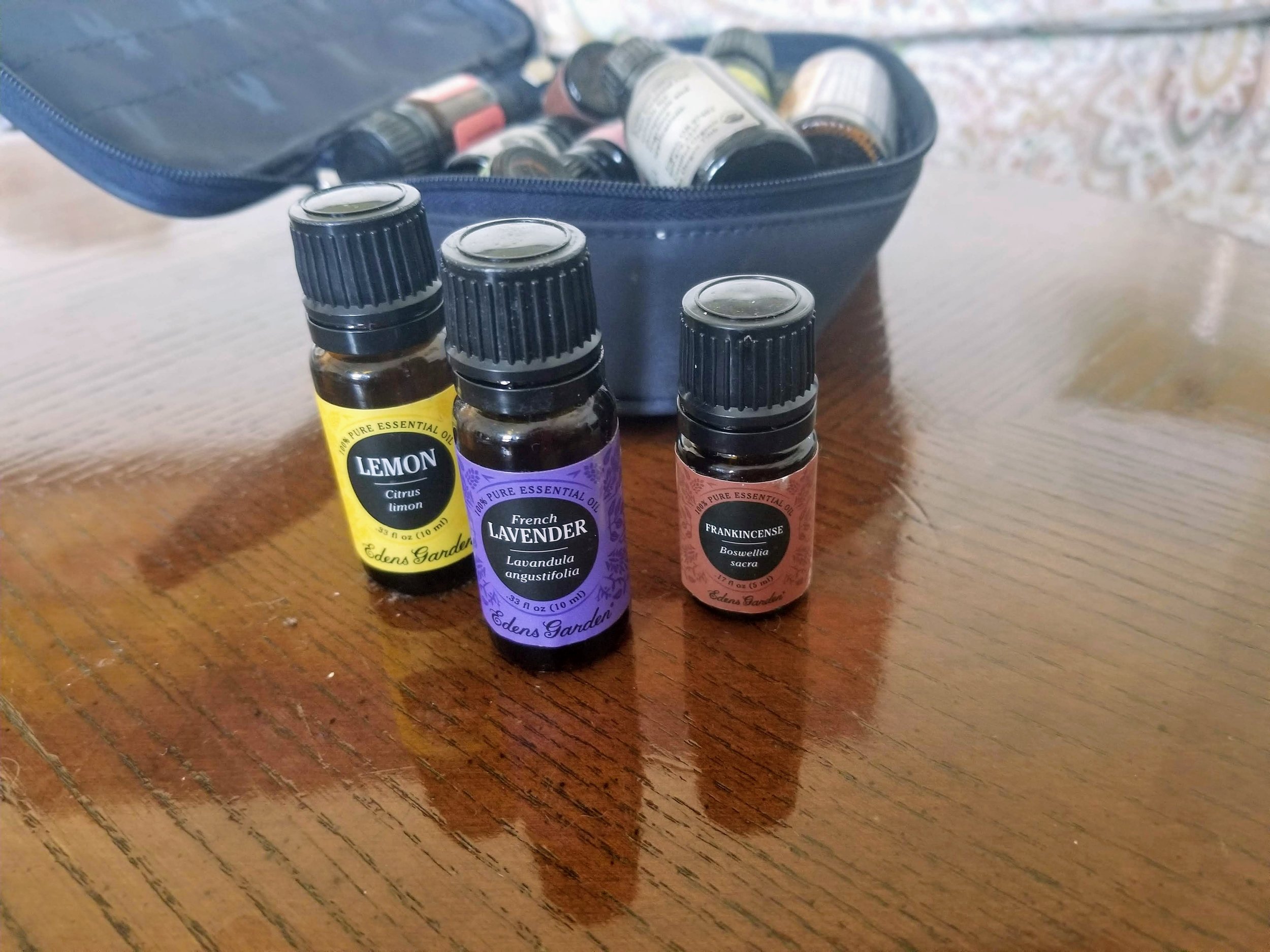
Lavender, lemon, and frankincense essential oils, the only three essential oils you need.
Lemon or other citrus oil (tangerine, bergamot, grapefruit, or sweet orange).
Citrus oils are safe during pregnancy and for children over 3 months. Citrus oils are uplifting. Lemon is a great choice for nausea, or an afternoon pick-me-up. Lemon essential oil can be used to clean and removes odors. It can be added to oil to polish furniture or mixed with water and sprayed to remove bad odors.
The main caution with citrus oils is that they are photosensitive, which means if you wear them on your skin, they will increase your chances of becoming sunburned.
Lavender for letting go.
You open up a bottle of lavender, smell it, and go “Ahhhh” It’s perfect to calm anxiety and soothe nerves.
Lavender was the first essential oil to be studied for it’s medicinal benefits. Lavender promotes relaxation and is wonderful on a cotton ball inside a pillow to aid sleep. Lavender soothes burns. It is safe for children but can cause uterine contractions, so is not to be used during pregnancy until after 37 weeks gestation.
During labor, lavender promotes a feeling of calm and encourages progress in a gentle way.
Frankincense
Of course frankincense always reminds us of the three wise men in the Christmas story. Frankincense has been used for hundreds of years in Ethiopia. Ethiopians use the frankincense sap to fill their homes with a beautiful smoky aroma during their traditional coffee ritual. They also use the smoke of the sap to flavor their butter.
Frankincense is very safe for children and during pregnancy. It is anti-aging, promotes skin integrity, and has been shown to shrink multiple types of cancer, including pancreatic, and skin.
Frankincense can be blended with oils or salves and applied to the skin. I think of it as an oil that creates sacred spaces.
How do you use essential oils? Do you have two or three go-tos?

Do midwives carry medications that would prevent me from bleeding too much?
The definition of a hemorrhage during a normal vaginal birth, is blood loss of more than 2 cups in the first few hours after birth, or more than 4 cups within the first 24 hours afterwards.
This is a good question to ask a midwife you want to hire because the answer is, it depends.
The definition of a hemorrhage during a normal vaginal birth, is blood loss of more than 2 cups in the first few hours after birth, or more than 4 cups within the first 24 hours afterwards.
There are the 3 types of medications typically used for postpartum hemorrhage in out-of-hospital settings. These are:
Synthetic oxytocin AKA pitocin.
Pitocin can be administrated in IV form or intramuscularly, as a shot in the thigh. In out-of-hospital settings pitocin is more often given via a shot. Pitocin works quickly to control bleeding but does not last longer than 10 minutes, so it may have to be repeated, if the bleeding is not controlled by then. It doesn’t have significant negative side effects, although there have been some studies that show it slightly delays milk production, and is correlated with slightly increased rates of postpartum mood disorders.
Misoprostol AKA cytotec
Cytotec works really well to cause contractions of the uterus to slow a hemorrhage. It also has the negative side effect of causing a potential fever and loose stools. It comes in pill form and is either given to the mom orally to chew up and put in her cheek or under her tongue, or it is administered rectally.
Methylergonovine Maleate AKA Methergine
Methergine cannot be given to women who have high blood pressure. It is administered orally in pill form, or intramuscularly via a shot in the leg. It works well to contract the lower segment of the uterus. Methergine has several negative side effects, including loose stools, lowered breastmilk production, changes in blood pressure, and nausea.
Choosing the right medication:
For most midwives I know who carry medications, they choose to use pitocin first as a medication during a postpartum hemorrhage. If the pitocin doesn’t work, they will usually repeat with a second dose of pitocin, or administer cytotec, or both, depending upon the severity. Midwives usually use methergine for too much bleeding that occurs several hours after birth or if the mother doesn’t respond well to other therapies.
So ask your midwife, does she carry medications to prevent too much bleeding? If so, which ones? What is her usual guideline for controlling and preventing too much bleeding? The answer depends upon the individual midwife and the locality she practices in.

What to do and what NOT to do if you're exploring home birth as a first time mom!
Women who come from families where natural birth is the norm tend to have straightforward natural births. Why? Because they’ve been thinking about birth as normal their entire lives. Some of us have to work hard during pregnancy to undo all the subtle messages we’ve been told-that our bodies don’t work well or we just aren’t strong enough.
So you’re interested in having a home birth, but not sure if it’s a good idea since you haven’t had a baby before? Trying to decide if you’re crazy, dumb, or doing the right thing?
How do you decide?
First of all, you’re courageous to ask questions and seek out answers! You could have just signed up with the local ob group at your closest hospital, not knowing anything about them. But you are brave, you educate yourself about your options.
Here’s some things to keep in mind as you decide what’s best for you and your family:
-Remember you Remember
Your birth story will be with you for the rest of your life (Simpkin, 1991)! Set yourself up for a good one. Think about where you feel safe and who you feel safe with. What things do you like? What makes you feel comfortable? How do you want to remember your experience?

Sometimes finances come into play when deciding who to use as a care provider. Keep the long term in mind as you decide who to hire. If you really want to have a home birth, but aren’t sure you want to spend the money on it, think, “What would I think of this decision I made 10 years from now?” You won’t regret spending money on the experience you want!
-Discover your overarching goal

Planning a home birth means you have a high chance of having a natural vaginal delivery and a low chance of having a cesarean. You have a low rate of interventions and a high rate of breastfeeding success. For a first time mom planning a home birth, compared to a mom who has had babies before, you have a higher chance of deciding to go in for pain relief or needing to go to the hospital for better monitoring or IV fluids. Research transfer rates for first time moms (or ask midwives). Compare cesarean rates for first time moms at local hospitals. Many hospitals have a first time mom cesarean rate close to 50%!!!
What’s your overarching goal? Is it breastfeeding success? A natural or vaginal delivery with as few interventions as possible? To give birth in a place you feel safe? Is it worth the risk to plan a home birth and know you may transfer to a hospital? Is it worth it to plan for a natural hospital delivery, and know you may have a much higher chance of having a cesarean? These are questions you can only answer for yourself, but keeping in mind you will remember it, and surrounding yourself with positive people will help guide you.
-Don’t be Afraid to Change Plans
The process of pregnancy, birth, and parenting, is a journey. At the beginning of your pregnancy you may want your best friends, mom, husband, and doula there. As things get closer to your due date, you may realize you just want it to be your partner and doula. It’s okay to change plans last minute! It’s better to switch care providers at the end than to stay with one who is going to push unnecessary interventions upon you.
When women get close to giving birth, they enter a deeply primal state. They crave darkness, warmth, quiet, and a place of safety. These are necessary for the cascade of hormones that promote physiological birth. They are harder to create in certain environments. At the end of pregnancy and in labor, women become instinctual. Listen to that instinct.
-Pursue Positive People
My biggest piece of advice to first time parents who want to have a natural birth is to surround yourself with positive birth stories. Women who come from families where natural birth is the norm tend to have straightforward natural births. Why? Because they’ve been thinking about birth as normal their entire lives. Some of us have to work hard during pregnancy to undo all the subtle messages we’ve been told-that our bodies don’t work well or we just aren’t strong enough.
“Ina May’s Guide to Childbirth”, “Spiritual Midwifery”, “Everyday Birth Magazine”, and “Birth Without Fear” are some great resources for good stories. Find your friends and family who have had natural or positive births and listen to their stories. Go to a local ICAN meeting or find a local home birth support group. In Cincinnati we have both the Home Birth Circle group on Facebook and the Home Birth Collaborative (http://cincinnatihomebirthcollaborative.com/) . The Home Birth Collaborative holds monthly meetings where home birth families share experiences with potential home birthers.
Stay clear of naysayers. I’m talking about care providers too! If your care provider is speaking negatively to you about your ability to give birth, or says that you should be induced because your baby might be too big, run! “There’s such thing as induction police!”

References:
Simkin, P (1991). Just another day in a woman’s life? Women’s long term perceptions of their
first birth, pt 1. Retrieved from: https://www.ncbi.nlm.nih.gov/pubmed/1764149

One Midwife's Quick and Dirty Guide to Women's Health Websites
Becoming a midwife was a journey that began in middle school as I pursued interests in herbalism and nutrition. Along the way, I discovered websites that influenced how I care for my body, shifted my thinking, or gave me a better understanding of how my hormones work.
As a lifelong learner, midwife, and woman, there are many resources I use and share with the people I love and work with. Becoming a midwife was a journey that began in middle school as I pursued interests in herbalism and nutrition. Along the way, I discovered websites that influenced how I care for my body, shifted my thinking, or gave me a better understanding of how my hormones work. I want to share these with you. I’ve listed them in the order that I found them because it seems one thing leads to another.
The Museum of Menstruation: http://mum.org/
This website altered the way I thought about my period when I discovered it as a teenager. Learning about the culture of menstruation throughout time was really empowering to me. I think it’s important to remember that the way our current culture views menstruation, and the way we menstruate, may be vastly different from the way it has been in other times and societies.
Pelvic Guru: https://pelvicguru.com/2013/01/12/the-ultimate-pelvic-anatomy-resource-articles-links-and-videos-oh-my/
This website is really important for a thorough understanding of pelvic anatomy. Check out: https://pelvicguru.com/2015/01/10/your-vagina-is-not-cussing-good-simple-vulvovaginal-hygiene-tips/
It is a great resource for pelvic pain and pelvic physical therapy.
Katy Bowman’s Blog, https://www.nutritiousmovement.com/blog/
The reason this resource is so important is because it challenges the way we think about movement and alignment, Kegels and incontinence, using a toilet or squatting in yoga. She also explains the impact poorly designed shoes have on pelvic (and overall) health and has compiled a recommended list of healthy shoes.
Put a Cup in It: https://putacupinit.com/
Because menstrual cups are the best, and you deserve one that’s comfortable and fits you well!
Author of “Womancode”, Alisa Vitti’s website: https://www.floliving.com/blog/
Without a doubt, her book changed my life! I had been learning about menstrual cycles, fertility, and nutrition for the past 10 years but when I read her stuff, it all clicked! I highly recommend her book and blog, especially if you struggle with endometriosis, PCOS, painful cycles, or infertility. Her story of healing her PCOS is so inspiring!
Cooking for Hormone Balance: https://hormonesbalance.com/recipes/
I discovered this resource a few months ago. What I love about this last website is the recipes. It’s really hard to be diligent about eating healthy foods when you are struggling with hormone imbalance. Your body craves those rich comfort foods! Magdalena has an inspiring story and her recipes are influenced by her experiences living in Poland, China, Iceland. Her recipes are all gluten, dairy, and egg free, but full of hormone nourishing fats.
So what’s your favorite women’s health website?

Try this stress relieving technique to help reduce anxiety
The Roving Body Check is a relaxation technique that combines patterned breathing with touch relaxation and guided imagery.
When you are in a situation where you feel your heart rate pounding faster, your
stomach tightening, and your breathing becoming shallow, you are experiencing a surge of
adrenaline. Adrenaline is the “fight or flight” hormone that is released when we are
stressed. Relaxation is important in stressful situations to prevent fear and tension.
When we have adrenaline rushes we need to bring our bodies down to earth. Feel the
floor. Listen to your breathing when you inhale and exhale. Look around the room.
Remember that fear is False Evidence Appearing Real.

Feel the floor
The Roving Body Check is a relaxation technique that combines patterned breathing with touch relaxation and guided imagery. Notice that “every out-breath is a relaxing breath.” Let your tension flow out of you when you exhale. While you are breathing in, note a particular area where there is tension. Have your partner or friend place their hand firmly on that part. When you breathe out, focus on releasing tension in that area. As you exhale your partner or friend will relax pressure on that part. Repeat this over different tensed body parts. Body parts to focus on: brow and jaw, back of the neck, shoulders and arms, one or both hands, back of the chest, small of the back, hips, and buttocks.

The Roving Body Check
Notice that “every out-breath is a relaxing breath.”
Similarly, you can find a comfortable position that does not require much energy. As you stay in this position actively work on relaxing each body part from the top of your head down to your toes. Tell yourself what part you are relaxing as you go down. When you learn to actively relax your muscles you can eliminate pain and stress.
For practice you can do these techniques while holding a piece of ice in your hand to feel how it reduces the pain.
Relaxation and breathing exercises can be practiced during pregnancy before birth. Abdominal breathing is especially helpful because it increases circulation throughout your body and relaxes your nervous system.
Nervous about how you are going to handle the pain in labor? Check out our doula services below. We are experts in teaching natural techniques for coping with pain.

References and Resources:
DONA International (2011) Birth doula workshop manual
Strange, K. (2012) Simple tools for mothers handout.

Packing your birth bag? Don't forget these foods!
It’s important to fill your birth bag with food for yourself and your loved one. Not only will it be helpful during your labor, but also for the recovery after.
Protein will ground you. It will give you endurance and energy for the long haul. It will help stabilize your blood sugars and help you and your loved one feel less anxious.

It’s important to fill your birth bag with food for you and your loved one
Not only will it be helpful for your labor, but for your recovery after. What foods should you pack? Here are some suggestions:

Protein will ground you.
It will give you endurance and energy for the long haul. It will help stabilize your blood sugars and help you and your loved one feel less anxious.
Protein suggestions:
Cheese and salami, which are good sources of sodium and calcium, important electrolytes.
Yogurt or a smoothie
Nuts, trail-mix, a bar, or sweet nut clusters from Trader Joe’s or Costco. Nuts are good sources of trace minerals.
Eggs or any kind of protein you can stomach. I’ve seen a mom munch on chik-fil-a chicken, sitting on the toilet, in between contractions

Fresh fruit for energy
Eating fresh fruit is a great way to boost energy quickly. It’s important the fruit is bite-size so a laboring mom can eat one or two pieces in between contractions. Fruit is a great source of vitamin C for immune system support and potassium for electrolyte balance.
Fresh fruit suggestions:
Grapes are easy to bring. Try freezing them for a delicious treat!
Berries such as blackberries, raspberries, and blueberries are full of antioxidants, which reduce inflammation. Plus, they already come bite-sized!
Bananas are portable and don’t require refrigeration.
Melons can be sliced up and prepared ahead of time for the big day.

Salt for electrolyte balance
Having a baby is hard work! Your body needs fuel to help your muscles work properly.
Your uterus, the strongest muscle in your body, will work best if you have been staying hydrated by drinking enough liquids and eating foods which provide electrolytes. Electrolytes are the minerals, calcium, magnesium, sodium, potassium, chloride, phosphate, and bicarbonate. They regulate muscle and nerve function. Electrolyte imbalance can occur from dehydration caused by excess vomiting or diarrhea, which sometimes occur with labor. If your electrolytes are imbalanced, you may experience a headache, fatigue, muscle cramps, or weakness. Pack a salty snack to include electrolytes sodium and chloride.
Salty suggestions:
Potato chips. These are my favorite. If I think a mom I’m supporting is really dehydrated, I will add more salt to the chips.
Crackers are easy to digest and readily available.
Popcorn is salty, buttery, and comes in small pieces.
What’s your favorite snack?
Not sure what to bring to the hospital? Schedule a free consultation! Call (513) 399-7263

Eat these 3 Foods to Balance Hormones Naturally
Tired of PMS symptoms? Wondering if you can afford fertility boosting foods? Curious about which foods to incorporate into your Diet? You’ve come to the right place!
Tired of PMS symptoms? Wondering if you can afford fertility boosting foods? Curious about which foods to incorporate into your Diet? Here are 3 suggestions

1. Root Veggies
Root vegetables balance hormones by balancing blood sugar through fiber. Carrots are especially helpful for preventing estrogen dominance. Sweet potato contains compounds that boost progesterone levels. Radishes, onions, garlic, turnips, parsnips, celeriac, and rutabaga balance hormones by providing food for the healthy bacteria in our gut.
Carrots and radishes are easy to eat raw with dips. Turnips, parsnips, and rutabaga are easy to incorporate into soups and stews. Root vegetables can be roasted with olive oil or lard and eaten with sausage, or boiled, mashed, and whipped with butter to make a delicious mashed potato replacement. For extra micronutrients, buy rainbow varieties of carrots, potatoes, and radishes (Trader Joe's is the best grocer I know for making rainbow vegetables available at an affordable price).

2. Seeds
Seeds are great sources of blood sugar balancing fiber, minerals, micronutrients, and hormone balancing omega 3 fats. Chia seeds for example, are a great source of iron, fiber, and omega three fatty acids. Pumpkin seeds contain compounds that balance gut bacteria and prevent the overgrowth of yeast and pathogenic bacteria. Flax seeds are a good source of omega three fatty acids and selenium, which promote hormone balance.
For a seed that is rich in iron and has a calming effect, incorporate poppy seeds.

If you are looking to conceive
or balance out your hormones naturally, incorporate ground flax, chia seeds, and pumpkin seeds into your diet for the first 15 days of your cycle. Switch to sunflower and sesame seeds for the latter half. Sesame seeds are rich in calcium and delicate omega 6 fatty acids.
I like to incorporate chia seeds into smoothies and make chia seed pudding. To make chia seed pudding, soak ½ cup of chia seeds in a mason jar with 1 can of coconut cream for 30 minutes. Add water or almond milk to bring to the desired consistency. You can eat chia seed pudding with berries, bananas and coconut flakes, maple syrup, or chocolate chips.
I add pumpkin, ground flax, and sunflower seeds to salads or yogurt and kefir.

3. Dark Leafy Greens
Crucifers such as broccoli, kale, cabbage, bok choy, arugula, cauliflower, collard greens, and brussel sprouts have been shown to rid the body of harmful estrogen.
Dark leafy greens are rich in micronutrients, vitamins such as vitamin K, A, and B vitamins, and trace minerals. Aim for two cups of dark leafy greens per day in the form of salads or cooked vegetables. Stir fry, saute, roast, add to soups and omelettes, incorporate into stews, eat in salads. This food is so healing!
Sprouts are an easy and affordable way to add micronutrients to your diet. You can buy radish or broccoli seeds and sprout in mason jars. Use the sprouts in sandwiches, salads, or as garnish for stews, tacos, or bean dishes.
Have you tried incorporating seeds into your diet?
For more information, follow us on Instagram, Facebook, or YouTube.

5 Things You Didn’t Know You Need for Home Birth
“Dehydration and electrolyte imbalance can cause uncoordinated uterine contractions and lead to a longer, more painful labor. “

Utility bill
A copy of your ID and proof of address
1. Copy of your ID and proof of address.
When midwives go to file the birth certificate, the health department needs to see a proof of residence. If you move late in pregnancy, it may be a good idea to visit the Bureau of Motor Vehicles to update your license before you have the baby.
2. Depends.
Did you know they now make them in a variety of fun colors? They used to only be available in peach or lavender. Depends are great for the first 24 to 48 hours when your lochia (that’s the word for the normal postpartum bleeding that occurs as the endometrium sheds and the placental site heals) is like a heavy period. The great thing about Depends is you don’t have to worry about extra laundry. Plus, depends have better back protection than heavy duty pads so you don’t have to worry about soiling your sheets when you are snuggling in bed with your baby.

Toilet paper…
3. Extra toilet paper.
If you’re having a home birth, chances are good you’ve hired a midwife and her team, who will be with you in your house from when you go into active labor, until a few hours after the baby is born. Your body will also be making room for a baby to come out, so trips to the bathroom are frequent. It’s important to have extra toilet paper on hand!

Epsom salts or liquid calcium magnesium.
Dehydration and electrolyte imbalance can cause uncoordinated uterine contractions and lead to a longer, more painful labor.
4. Epsom Salts or Liquid Calcium Magnesium.
Magnesium deficiency can cause leg cramps and lots of Braxton Hicks contractions. It’s helpful to have epsom salts on hand for a soak in the tub if you aren’t sure whether you’re really in labor. You can find epsom salts in the pharmacy section of the grocery store or in any pharmacy. It’s also helpful to have liquid calcium-magnesium around at the end of pregnancy, in case you have leg cramps or are having a lot of uncomfortable contractions which are making it difficult to sleep. My favorite brand of liquid calcium-magnesium is Integrative Therapeutics, which you can find on Amazon
5. A Sense of humor
Whether it’s because you are trying to prevent your four-year-old from drinking the birth pool water, or need to laugh as you put on the “one-size-fits-none-victoria’s-secret-special” stretchy panties, this part is crucial. Humor is also a great way to encourage labor and can help you cope when you’re past your due date and not sure if you are EVER going to have the baby.
Need an idea for some laughs? Check out Jim Gaffigan’s Mr Universe here
What items did you find unexpectedly helpful for your home birth?
Be sure to like us on Facebook here